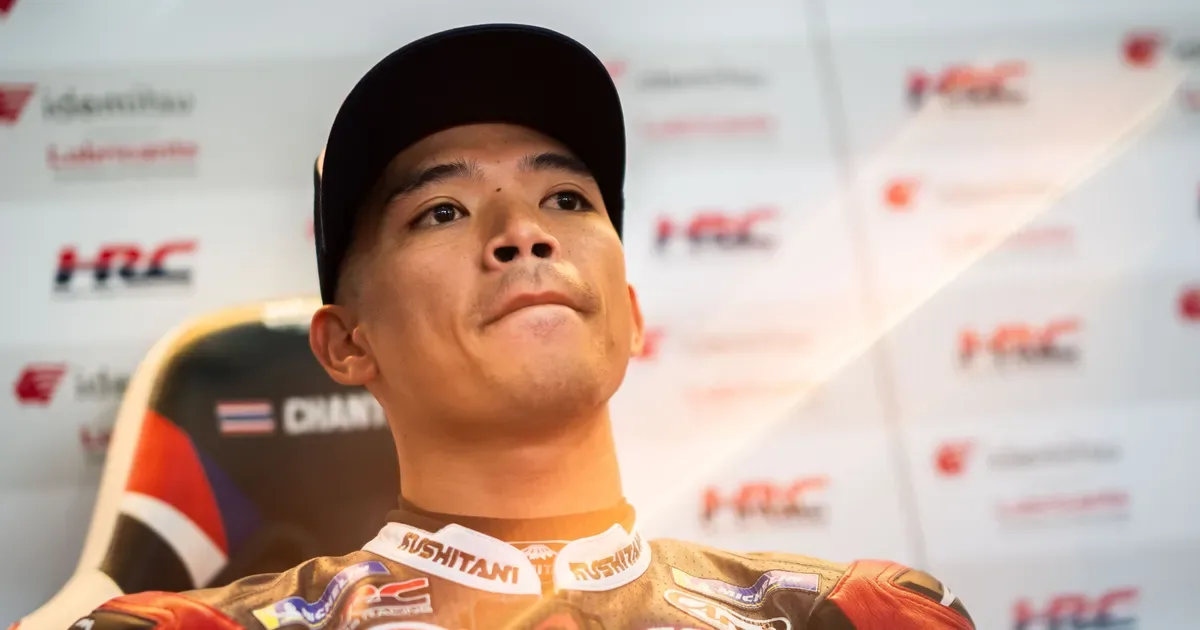
Honda will bring Somkiat Chantra back to the MotoGP grid for the Japanese Grand Prix, placing the Thai rider in Joan Mir's Honda HRC Castrol seat while Mir continues a medical recovery programme. The assignment gives Chantra a return to the premier class at Motegi, a circuit tied to one of the defining results of his career.
Honda's decision was confirmed on September 23. MotoGP reported that the medical concerns affecting Mir were first raised after the San Marino Grand Prix. The manufacturer has not framed the change as permanent: Chantra is the substitute for Japan, while Mir will continue his recovery and Honda expects to provide a further update on his condition after the Indonesian Grand Prix.
A familiar rider in an unfamiliar season
Chantra is not arriving as a MotoGP newcomer. He raced in the premier class with Honda LCR during the 2025 season and finished 15th at Motegi that year aboard the Honda RC213V. That recent experience gives him knowledge of MotoGP's procedures, the motorcycle's performance level and the intensity of a full Grand Prix weekend.
His regular 2026 programme has been in the Superbike World Championship with Honda Racing Corporation. According to MotoGP, he has scored points on seven occasions during a campaign also shaped by recovery from pre-season injuries. Moving between WorldSBK and MotoGP is demanding because the motorcycles, tyres, electronics and weekend structures are distinct, even when the rider remains inside the same manufacturer's racing organization.
The substitution therefore carries two competing advantages. Chantra understands Honda's racing culture and has recent RC213V experience, but he has spent the current season adapting to a production-based superbike rather than developing week after week on a MotoGP prototype. Friday practice at Motegi will be important for rebuilding references and determining how quickly he can reconnect with the prototype.
Why Motegi matters
The Mobility Resort Motegi is more than Honda's home venue. It is also the site of Chantra's memorable Moto2 victory in 2023. Returning there in factory Honda colours adds a strong personal and organizational thread to the weekend without changing the practical task: learn quickly, communicate clearly with the engineering crew and complete the programme Honda needs in Mir's absence.
Home rounds bring particular attention to Japanese manufacturers. Corporate guests, employees, dealers and long-time supporters have a closer view of the racing operation, while every result is examined through the lens of the brand's domestic identity. Chantra's selection gives Honda a rider with a proven connection to the venue and current experience inside HRC.
The announcement also broadens the audience around the event. Thailand's first MotoGP rider carries significant visibility in Southeast Asia, and his return arrives during the championship's run of overseas rounds. For MotoGP, rider movement across major series can create interest beyond the usual points-table narrative. For Honda, it demonstrates the value of maintaining talent across multiple factory programmes.
The Canadian viewing angle
For Canadian fans and dealerships, the story is primarily about competition rather than a retail product announcement. Nothing in Honda's statement changes Canadian motorcycle availability, specifications or pricing. The relevance comes from the way factory racing programmes share riders and knowledge across championships.
Honda dealers with customers who follow road racing can use the Japanese round as a timely connection between the brand's showroom identity and its prototype programme. The RC213V is not a production motorcycle, and it should not be presented as one. Still, racing remains a visible part of Honda's engineering story, and a substitute appearance at the manufacturer's home event will generate discussion among sport-bike riders.
The weekend may also give Canadian viewers a useful comparison between Chantra's current WorldSBK form and the different demands of MotoGP. Finishing position alone will not tell the whole story. Practice pace, adaptation over the sessions, feedback to the team and race completion will all provide context for an athlete changing machinery on short notice.
What to watch at Motegi
The first factual checkpoint will be Chantra's participation in opening practice. From there, qualifying position and his ability to narrow the gap through the weekend will show how quickly he has rebuilt MotoGP rhythm. Honda's official comments after each session should clarify the goals of the substitution and the value of his feedback.
Mir's recovery remains a separate story and should not be inferred from Chantra's performance. Honda has said the next update on Mir is expected after the Indonesian Grand Prix. Until then, the confirmed facts are limited but important: Chantra is back on a MotoGP Honda for Japan, Motegi is a circuit he knows well, and the opportunity links two of HRC's international racing programmes at a high-profile home event.