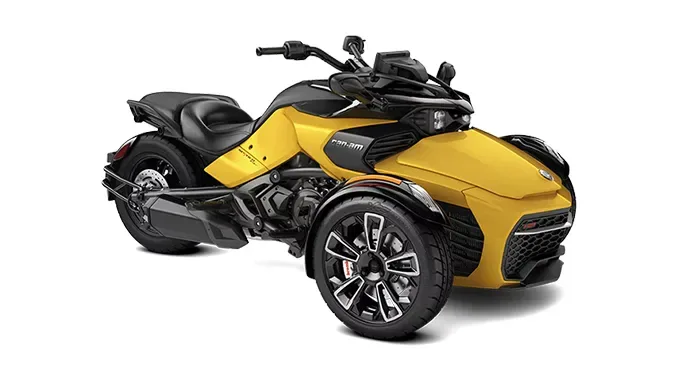
Bombardier Recreational Products is recalling 14,014 Can-Am motorcycles and three-wheel vehicles in the United States because the touchscreen instrument cluster may reset, freeze or go blank, potentially removing critical information such as vehicle speed and warning lights.
The U.S. National Highway Traffic Safety Administration campaign is 26V575000. The recall covers certain 2025-2026 Can-Am Origin and Pulse motorcycles, 2025-2027 Can-Am Canyon models, and 2024-2027 Can-Am Spyder F3 and Spyder RT models equipped with the touchscreen instrument cluster.
The recall is especially relevant to Canadian powersports readers because BRP is a Canadian manufacturer and the affected Can-Am product families are sold in Canada. However, the 14,014-unit figure is the U.S. recall population. At publication, RideFirst could not verify a matching Transport Canada campaign for this instrument-cluster issue, so Canadian owners should not assume that a U.S. campaign automatically means their Canadian-market vehicle is included.
What the U.S. recall says
NHTSA says the touchscreen instrument cluster may reset, freeze or go blank.
When the display becomes inoperative, the rider can lose access to critical safety information including vehicle speed and warning lights. NHTSA says that can increase the risk of a crash.
The agency also identifies the issue as a non-compliance with U.S. Federal Motor Vehicle Safety Standards 123, covering motorcycle controls and displays, and 122, covering motorcycle brake systems.
The listed U.S. model-year ranges are:
- 2025-2026 Can-Am Origin
- 2025-2026 Can-Am Pulse
- 2025-2027 Can-Am Canyon
- 2024-2027 Can-Am Spyder F3
- 2024-2027 Can-Am Spyder RT
Not every vehicle within those model-year ranges is necessarily affected. Recall coverage is ultimately determined by the vehicle identification number.
The remedy is software-based
According to the U.S. filing, BRP will correct the issue with an instrument-cluster software update.
The update can be completed over the air or by a dealer and will be provided free of charge for vehicles included in the U.S. campaign.
Owner notification letters are expected to be mailed October 12, 2026. NHTSA says affected VINs are expected to become searchable in its recall database beginning September 22.
That makes this materially different from a mechanical campaign requiring replacement of a major component. The repair is software-based, although owners still need to confirm whether their individual vehicle is covered and whether the update is available for their market.
What Canadian owners need to know
This is where geography matters.
NHTSA campaign 26V575000 is a United States recall. The 14,014 affected-unit estimate published with the campaign should not be presented as a Canadian recall count.
RideFirst checked the current Transport Canada recall information and Can-Am Canada's safety-recall resources while preparing this report and did not locate a corresponding Canadian instrument-cluster campaign matching 26V575000.
That does not prove that Canadian vehicles are unaffected.
Recall campaigns can be published at different times in different countries, and the same model may have different certification, software or production populations depending on market.
Canadian Can-Am owners concerned about a touchscreen cluster that resets, freezes or goes blank should check their VIN through BRP's Canadian safety-recall lookup and contact an authorized Can-Am dealer if they need confirmation.
Why the recall matters to dealers
The affected product list crosses several important Can-Am categories.
Origin and Pulse are BRP's electric motorcycles. Canyon is the company's adventure-oriented three-wheel platform, while Spyder F3 and Spyder RT represent established three-wheel touring and sport-touring products.
For dealers, that means the issue is not confined to one narrow model family.
Service and sales teams should avoid telling customers that every 2024-2027 Can-Am three-wheeler is recalled. The published U.S. campaign applies only to specified models, model years and affected VINs equipped with the touchscreen cluster.
The correct dealer response is VIN verification and market-specific recall confirmation.
A second reason Canadian riders should pay attention
The timing also matters because BRP's on-road lineup is already receiving unusually high attention in Canada.
Can-Am has expanded its motorcycle and three-wheel portfolio, including the Origin, Pulse and Canyon, while the Spyder remains one of the most recognizable products in BRP's on-road business.
A software recall touching both the newer electric motorcycles and established Spyder products is therefore more consequential than a routine single-model service bulletin.
The recall does not establish that all touchscreen-equipped Can-Am vehicles will experience a failure, and it should not be interpreted as evidence that the motorcycles are unsafe once the campaign remedy is completed.
It does establish that U.S. regulators and BRP have identified a display failure significant enough to require a formal recall.
What owners should do
U.S. owners should verify their VIN through NHTSA or BRP and follow the recall instructions applicable to their vehicle.
Canadian owners should use BRP Canada's recall lookup, monitor Transport Canada and contact an authorized dealer rather than relying on the U.S. model list alone.
Owners experiencing an instrument display that resets, freezes or goes blank should not assume the problem is merely cosmetic. The display contains safety-critical information, and the U.S. recall specifically identifies loss of speed and warning-light information as the safety concern.
Bottom line
BRP's new U.S. recall covers up to 14,014 Can-Am Origin, Pulse, Canyon, Spyder F3 and Spyder RT vehicles because their touchscreen instrument clusters may reset, freeze or go blank.
The repair is a free software update delivered over the air or by a dealer.
For Canadian readers, the key distinction is equally important: the campaign published so far is a U.S. NHTSA recall, and RideFirst has not verified a matching Transport Canada campaign for the same instrument-cluster issue at publication.
Canadian owners should verify their own VIN with BRP and watch for any Canadian recall notice rather than assuming the U.S. population and remedy automatically apply here.