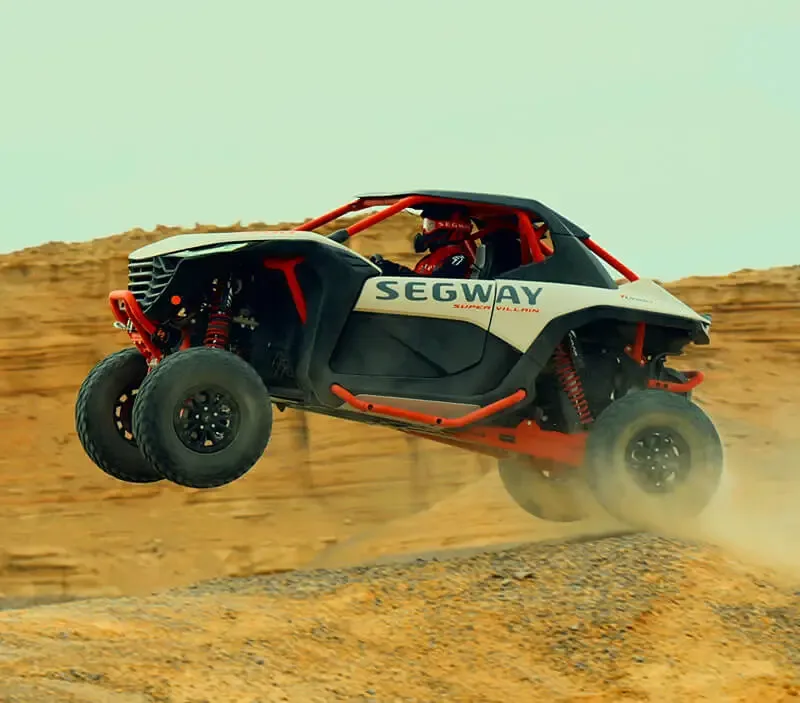
Segway Powersports is taking its Super Villain side-by-side into one of the environments most capable of exposing a machine's weaknesses: King of the Hammers.
The manufacturer revealed September 22 that it is partnering with Mark McCleerey and Turn'd Up Racing to enter the Super Villain in the KOH 4900 UTV class.
The program represents a significant change in terrain for a vehicle whose competition development has so far been heavily associated with high-speed desert running.
Instead of long stretches where suspension travel, horsepower and cooling dominate the engineering conversation, rock racing adds crawling, wheel placement, driveline shock, chassis clearance and traction to the list.
For Segway, that makes King of the Hammers less of a conventional sponsorship exercise and more of an engineering stress test.
From desert speed to technical rock terrain
Segway says the Super Villain has already accumulated thousands of competition miles in the desert, including events such as Vegas-to-Reno and the Silver State 300.
The next step is to take that platform into the rocks.
McCleerey brings direct experience in the discipline. Current Ultra4 results list him within the 4900 UTV Open field, which gives Segway a driver familiar with the kind of terrain and race preparation the program will encounter.
That matters because King of the Hammers is not simply another high-speed off-road race.
The Johnson Valley event combines the characteristics of desert competition with extreme technical terrain. A vehicle can need speed in one section and controlled low-speed crawling in another, putting very different loads through suspension, steering, drivetrain and cooling systems.
A machine optimized only for outright horsepower can quickly discover that horsepower is not the limiting factor.
A 235-horsepower starting point
The gasoline Super Villain SX20T is already an unusually powerful production side-by-side.
Segway's global product page lists the machine with a turbocharged 2.0-litre gasoline engine producing 235 horsepower and 380 N·m of torque.
The company also lists 20 inches of front suspension travel, 21 inches at the rear, 14.6 inches of ground clearance and selectable two- and four-wheel drive.
Those figures give the race program a strong starting platform, but King of the Hammers will ask different questions.
Can the drivetrain tolerate repeated high-load transitions as tires gain and lose traction?
Can steering components withstand direct impacts at low speed?
Can the cooling system manage long periods of slow operation where there may be less airflow?
Can suspension tuning provide both control over rocks and enough stability when speeds increase again?
Competition provides answers much faster than ordinary recreational use.
Segway is treating racing as development
That appears to be part of the manufacturer's strategy.
In announcing the McCleerey partnership, Segway described racing as a proving ground for the Super Villain platform rather than simply a promotional backdrop.
That approach is familiar across powersports.
Manufacturers have long used motocross, desert racing, snowmobile competition, road racing and endurance events to accelerate development. Racing concentrates loads and failures into a much shorter time window than normal consumer operation.
What is different for Segway is the company's relative youth in the North American powersports market.
Established ATV and SxS manufacturers have decades of racing history and dealer familiarity. Segway is still building those credentials.
A successful competition program can therefore do two jobs at once: produce engineering data and convince riders that the machines belong in serious performance conversations.
King of the Hammers is already preparing for 2027
The timing of Segway's announcement coincides with the opening of registration for the 2027 King of the Hammers.
Organizers opened racer registration on September 21 and announced a minimum 2027 purse of $250,000, split between Ultra4 racing and the Desert Challenge. Returning competitors have an early-registration discount available through September 28.
The overall 2027 King of the Hammers schedule runs from January 21 through February 6 in Johnson Valley, California.
That gives Segway and Turn'd Up Racing several months to develop the Super Villain for a substantially different type of competition.
The manufacturer has not yet released a detailed technical build sheet for the KOH vehicle, so it would be premature to assume exactly how closely the race machine will mirror the production SX20T.
That is one of the details worth watching as the program develops.
Why Canadian riders should care
Although King of the Hammers takes place in California, Segway's performance push has a direct Canadian-market connection.
Super Villain units are already present in the Canadian retail market, including dealer inventory in Alberta and Quebec. That means the platform being developed in competition is not an abstract overseas model with no connection to Canadian shoppers.
Canada also has terrain capable of highlighting many of the same qualities that matter in rock racing: steep climbs, uneven trails, mud, exposed rock and long distances between easy recovery points.
Production specifications and race performance are not interchangeable, of course. Consumers should not assume that a showroom vehicle is identical to a purpose-built competition machine.
But the development process can still influence future calibration, components and engineering decisions.
What a race program can reveal
Competition mileage is useful because it compresses wear, heat and repeated impacts into a short operating window. Engineers and race teams can see which parts loosen, overheat, bend or become difficult to service after hours of severe use.
That does not mean every race component will transfer to a retail model. Purpose-built vehicles can use different protection, suspension tuning, tires, safety equipment and drivetrain calibration. The value is the information produced under stress.
For a relatively new powersports brand, public competition also creates a record that customers can follow. Finishing difficult races consistently can support a durability story in a way that a controlled demonstration cannot, while failures can identify where development still has work to do.
The performance SxS fight keeps intensifying
Segway's move is also part of a broader change in the side-by-side category.
The performance end of the market has become a technology contest involving turbocharging, sophisticated suspension, electronically controlled systems, large displays and increasingly powerful drivetrains.
Newer manufacturers cannot compete on specifications alone.
They have to prove durability.
Racing provides one of the clearest ways to do that because mechanical problems are difficult to hide when a vehicle is being pushed at competition pace in public.
For Segway, desert racing established one type of credibility.
King of the Hammers is intended to establish another.
If the Super Villain can transition successfully from open desert to technical rock racing, the result will tell buyers more about the platform than another horsepower figure or showroom display ever could.
And with the 2027 King of the Hammers now officially on the calendar, Segway has roughly four months to prepare for that test.