Canada’s motorcycle community meets in Québec
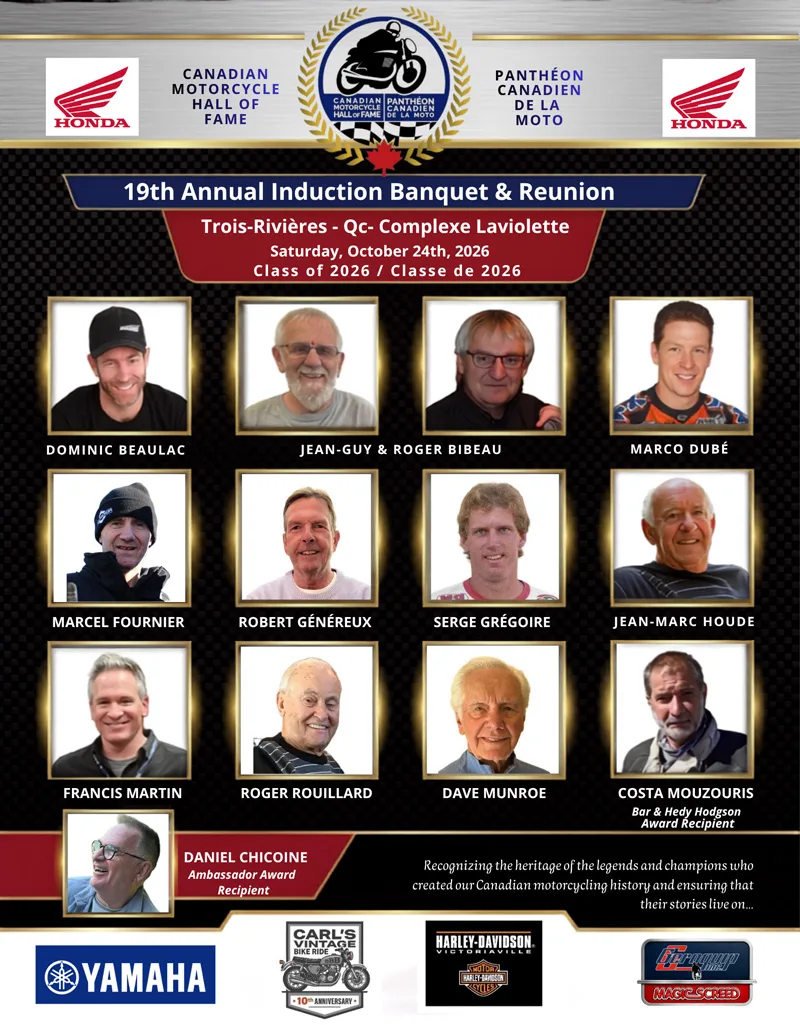
The Canadian Motorcycle Hall of Fame holds its 19th Annual Induction Banquet and Reunion tonight, October 24, at Complexe Laviolette in Trois-Rivières, Québec. The organization lists ticket sales as closed. The evening will formally induct the Class of 2026, present the Bar and Hedy Hodgson Award to Costa Mouzouris and honour Ambassador Award recipient Daniel Chicoine. Motorcycle displays, stage presentations and audiovisual tributes are also part of the program. The Hall announced the class and award recipients on June 10, ahead of tonight’s formal ceremony.
The Class of 2026
The announced inductees are Dominic Beaulac, Jean-Guy Bibeau and Roger Bibeau, Marco Dubé, Marcel Fournier, Robert Généreux, Serge Grégoire, Jean-Marc Houde, Francis Martin, Dave Munroe and Roger Rouillard. The Bibeaus appear together in the Hall’s class announcement. Their names are featured in the official event artwork alongside the two award recipients, giving attendees and other enthusiasts a guide to the people being recognized.
More than a racing awards night
The Hall of Fame describes its scope broadly. Competitors matter, but so do builders, contributors, organizations and people who strengthened Canadian motorcycling away from a starting grid. That breadth is important in a country where the sport and industry developed through local clubs, volunteer event organizers, independent shops, distributors, journalists, mechanics and advocates. A national hall can connect those regional histories. It also helps prevent important work from disappearing when a business closes, a track changes ownership or a generation of volunteers steps away.
Two awards with different purposes
Costa Mouzouris receives the Bar and Hedy Hodgson Award, which focuses on heritage preservation. The Hall says it recognizes a Canadian person, group or organization that has made a significant contribution through museums, displays, writing or conservation of historic machines. Daniel Chicoine receives the Ambassador Award, which recognizes a business owner or operator who has gone beyond ordinary commercial activity in contributing to motorcycling. Keeping the awards distinct acknowledges that preserving history and leading an industry both matter, but they are not the same task.
Why the location matters
Hosting the ceremony in Trois-Rivières places the national gathering in a province with a deep motorcycle culture and a distinctive regulatory and retail environment. The Hall notes that its banquets have moved across Canada, including previous events in Toronto, Montreal, Vancouver and Surrey. That travelling format is useful because Canadian motorcycling is not concentrated in a single city. A national institution earns relevance by showing up in different regions and allowing local communities to see their people and stories reflected on the stage.
Preservation has practical value
Heritage can sound separate from current dealership and riding concerns, but it has practical uses. Restored motorcycles teach mechanical evolution. Racing archives explain why certain brands and circuits retain strong followings. Oral histories preserve how clubs negotiated land access, how shops served remote riders and how Canadian competitors reached international events. For dealers, understanding that history can make anniversary displays, community nights and customer storytelling more authentic. It also creates an opportunity to connect older enthusiasts with younger riders without pretending every past practice should be repeated.
The role of sponsors and volunteers
The Hall of Fame operates as a non-profit charitable organization and says it is run entirely by volunteers. It lists more than 170 inductees honoured since the first ceremony in 2006. That structure makes the annual banquet a major operational undertaking: nominations must be reviewed, histories checked, families contacted and presentations produced. Industry sponsors help make the event possible, but the credibility of the institution depends on treating the record carefully and recognizing achievement across brands, disciplines and regions.
A useful bridge between generations
A reunion creates value that a list of names cannot capture. Long-time competitors and builders can meet current riders, while families can supply documents and memories that strengthen the archive. Those conversations may reveal photographs, race programs, shop records or machines that would otherwise remain private. The Hall’s role is to turn that material into a durable public history. For younger attendees, the event shows that Canadian motorcycling was built through decades of local work, not only through the most visible international champions.
A record that extends beyond the banquet
The October 24 ceremony brings the announced class together with families, colleagues and supporters. Readers who want to learn more can consult the Hall’s official class announcement and biographies, which connect individual careers to the wider history of motorcycling in Canada. The banquet gives those histories a public stage. Its longer-term value lies in keeping the names, achievements and supporting records accessible to riders who could not attend in Trois-Rivières.