Albert Arenas Clinches 2026 WorldSSP Championship in Rookie Season
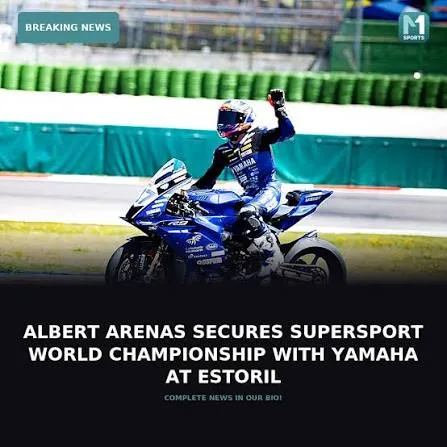
Albert Arenas is the 2026 FIM Supersport World Champion after finishing fourth in Race 1 at Estoril, completing a title-winning rookie season in the category. The Spanish rider secured the championship on Saturday while Tom Booth-Amos led a landmark one-two finish for PTR Triumph Factory Racing.
Arenas entered the Estoril weekend with the opportunity to close the championship before the final round. He qualified ninth, then moved forward quickly in Race 1 and spent much of the contest in the group fighting for the podium. Jeremy Alcoba passed him late for third, but fourth place supplied the points Arenas needed.
The result gives Arenas his second world championship. He previously won the Moto3 title in 2020 and now adds the WorldSSP crown after moving into the production-based middleweight class. WorldSBK’s official championship coverage identifies him as only the second Spanish rider to win the World Supersport title.
Saturday’s race carried several other milestones. Booth-Amos won by just 0.075 seconds over teammate Oli Bayliss, producing PTR Triumph Factory Racing’s first WorldSSP one-two. Alcoba finished third, only 0.147 seconds from the winner, while Arenas crossed the line 0.762 seconds behind.
The championship was also a broader Yamaha success. Arenas and Aldi Mahendra secured the Teams’ Championship for AS BLU CRU Racing Team, while Yamaha wrapped up its 12th WorldSSP Manufacturers’ Championship. That means the rider, team and manufacturer titles were all settled on the same Saturday at Estoril.
Arenas’ title stands out because of how quickly he adapted to a different racing environment. WorldSSP motorcycles are production-derived machines, and the class demands a different balance of braking, corner speed, tire conservation and setup than the prototype categories where Arenas built much of his earlier Grand Prix career.
The transition did not prevent him from becoming the benchmark over a full season. Championship racing rarely depends on one spectacular weekend. Arenas had to combine race-winning pace with enough consistency to build a margin that could survive difficult qualifying sessions and races where outright victory was not available.
Estoril was a good example. He did not need to chase an unnecessary final-lap risk after Alcoba moved into third. Fourth place was enough to secure the title, and the result rewarded season-long points management rather than a single-race gamble.
Sunday’s Race 2 changed the race winner but not the championship outcome. Jeremy Alcoba won a red-flagged contest in tricky conditions, while Arenas entered the day already confirmed as champion. The title had been decided by the cumulative work completed before that final Sunday race.
For Canadian riders, WorldSSP is particularly relevant because the class showcases motorcycles that retain a visible connection to middleweight sportbikes sold through regular dealerships. The race machines are heavily prepared and operate under championship technical regulations, but the category still gives enthusiasts a clearer line of sight between racing development and the production motorcycle market than prototype racing does.
The Triumph one-two also broadens the commercial significance of the weekend. Arenas delivered the championship for Yamaha and AS BLU CRU, while Booth-Amos and Bayliss gave Triumph a historic team result. Kawasaki placed Alcoba on the podium. Three manufacturers therefore left Race 1 with distinct achievements that can carry into showroom and track-day conversations.
The championship also adds another chapter to Arenas’ career. Winning Moto3 established him at Grand Prix level. Winning WorldSSP after changing disciplines demonstrates adaptability, especially in a field where racecraft, machinery management and close drafting battles can shape results as much as qualifying position.
For dealers and riders watching from Canada, the practical takeaway is that middleweight performance remains one of the most competitive parts of the sportbike market. Manufacturers are using WorldSSP to demonstrate reliability, chassis development and race support while riders with very different backgrounds compete on closely matched machinery.
Arenas no longer needs to defend a mathematical possibility. The 2026 WorldSSP championship is secured, and his first season in the class has ended with the largest result available: a world title.