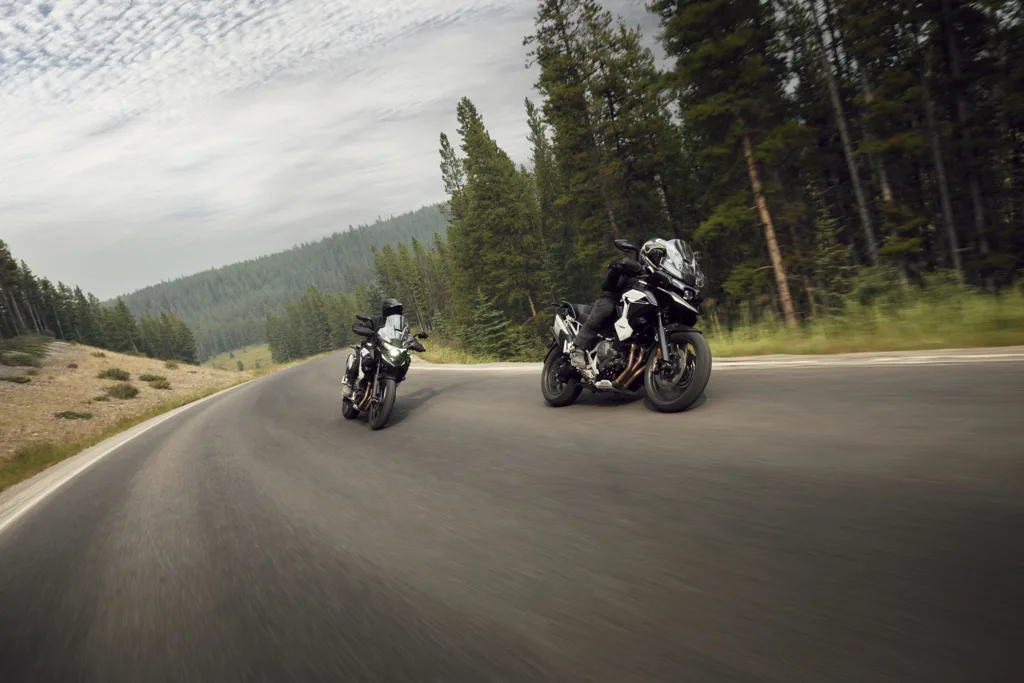
Triumph has rebuilt the Tiger 1200 proposition around accessibility, electronics and road handling without abandoning its long-distance mission. Revealed October 27, the new generation brings a stronger 1,160 cc triple, 19-inch front wheels across the range, self-lowering semi-active suspension, phone mirroring and front-and-rear radar. For Canadian riders, the most consequential change may be the way those systems work together to make a large adventure motorcycle less intimidating at low speed and easier to manage on long trips.
More power, with attention to low-speed control
The updated T-Plane triple produces 158 PS, or 155.8 horsepower, at 9,250 rpm and 130 Nm of torque at 6,750 rpm. Triumph says revisions include a redesigned cylinder head, new pistons, lighter valves, more precise injection and a freer-flowing exhaust. Revised lower-gear ratios and final-drive calibration reduce crawl speed, helping with parking-lot manoeuvres, traffic and technical terrain.
Refinement work extends to the crankshaft, balancer shaft, cam profiles, six-speed gearbox and shaft drive. That matters because a high-output specification can be undermined by driveline lash or abrupt response. The Tiger’s value proposition is strongest when it can cover highway kilometres smoothly, then remain predictable when the road narrows or the rider is balancing a passenger and luggage.
Heightflex changes the stop-and-go experience
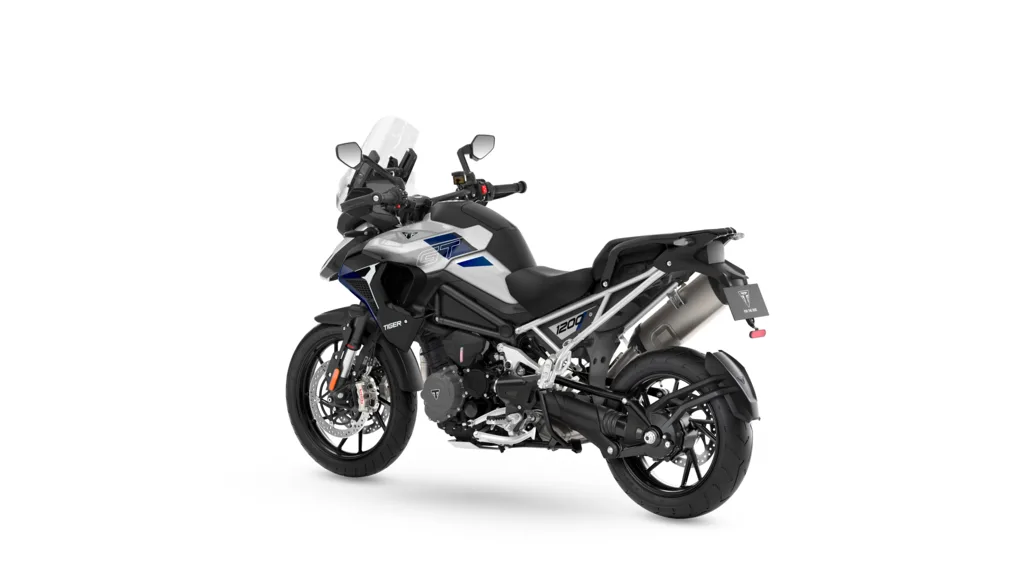
Showa EERA Heightflex semi-active suspension automatically lowers the motorcycle by 30 mm as it comes to a stop in road riding modes, then restores the correct ride height after moving away. A two-position seat adds 20 mm of adjustment, and a low-seat option can bring the standstill height to 790 mm. The system also includes a centre-stand-assist function that temporarily raises preload to reduce the effort needed to deploy the stand.
All four variants now use a 19-inch front and 17-inch rear wheel with 200 mm of suspension travel. GT versions use cast wheels, while Rally versions use side-laced spokes and add off-road equipment. The decision makes the whole family more road-biased than a 21-inch-front layout, but still leaves the Rally models equipped for unpaved travel.
A connected cockpit and radar network
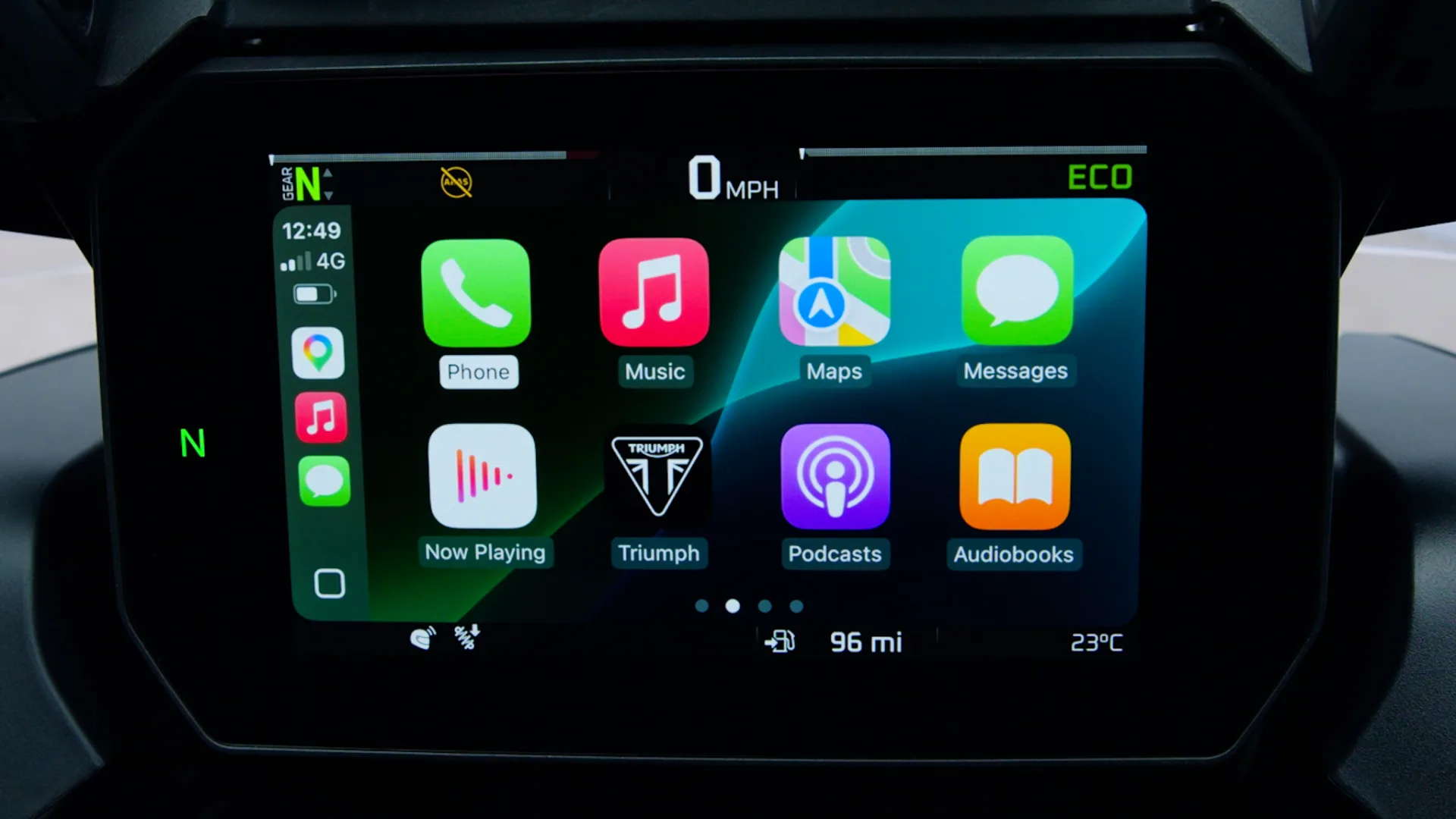
A new seven-inch Bosch touchscreen supports wireless Apple CarPlay and Android Auto. The interface can be operated by touch at very low speed, with the switch cubes while riding, or by voice through a compatible headset. A cooled, waterproof phone compartment in the tank includes USB-C charging. The display is rated for dust and water exposure and uses anti-glare glass.
Front and rear radar enable adaptive cruise control, group-ride assist, forward-collision warning, emergency-brake assist, blind-spot monitoring and rear-distance warning. These are assistance systems rather than substitutes for rider judgement, but they address common touring risks: closing speed, fatigue, traffic hidden beside luggage and inconsistent spacing in groups.
Four versions, two fuel capacities
The GT Pro, Rally Pro, GT Explorer and Rally Explorer share the core engine, suspension and technology package. Pro versions retain 20-litre tanks; Explorer versions use 30-litre tanks and add equipment for extended travel. Triumph lists up to eight riding modes depending on model, with Rally versions adding Off-road Pro. Explorer equipment also includes tire-pressure monitoring and handlebars positioned 10 mm higher and 10 mm wider than on Pro models. The Rally Explorer adds upper engine protection. These differences give buyers specific reasons to compare trims beyond fuel capacity and wheel construction.
Triumph’s North American launch sheet confirms Canadian starting prices of $25,995 for the GT Pro, $27,395 for the Rally Pro, $28,695 for the GT Explorer and $29,995 for the Rally Explorer. The motorcycles are available to order, with dealership arrivals beginning in December 2026. These are Canadian-dollar starting prices, not itemized out-the-door quotes. Buyers should confirm freight, preparation, taxes, accessories and their dealer’s actual delivery allocation before comparing the final purchase cost.
Why it matters in Canada
A large adventure motorcycle has to work across long distances, changing weather and mixed road conditions. The Tiger 1200’s strongest update is not any one headline feature but the integrated effort to reduce friction: a lower stop height, smoother low-speed drive, assisted centre-stand use, phone navigation and radar-backed distance awareness.
Dealers will need to demonstrate these systems clearly. Heightflex, radar settings and smartphone pairing are easiest to understand in person. Riders should compare standstill reach with the appropriate seat fitted, then check how the motorcycle feels with luggage or a passenger. The published equipment is promising, but a comfortable stop height does not establish whether every rider will find the motorcycle easy to balance, turn or manoeuvre.
Ownership costs will also shape the Canadian verdict. The service interval is 16,000 kilometres or 12 months, whichever comes first. Shaft drive removes chain cleaning and adjustment from routine touring tasks, while radar hardware, semi-active suspension and a large display add complexity. Warranty coverage, replacement-part pricing and technician training will therefore be important parts of the value equation when comparing Canadian ownership costs.