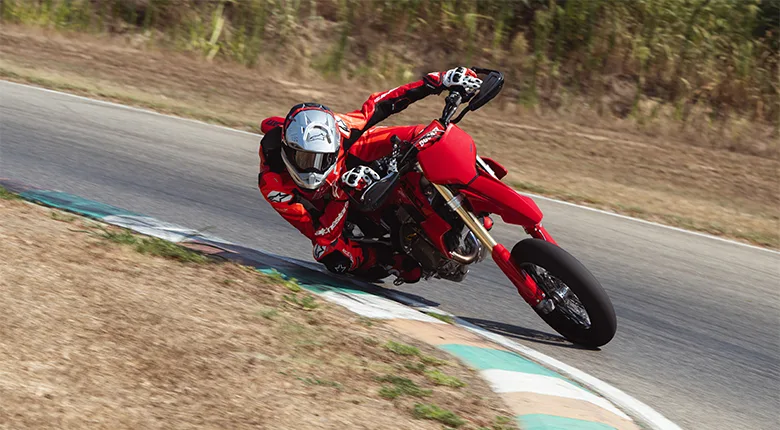
Ducati has officially launched the Desmo450 SM, its first purpose-built racing supermoto, giving the company’s 449.6 cc single-cylinder off-road platform a pavement-focused competition version.
The model was formally detailed September 17 after being unveiled during World Ducati Week. It is derived from the Desmo450 MX motocross platform, but Ducati has changed the chassis setup, wheels, brakes, suspension calibration, electronics and rider interface for supermoto use.
The result is a 63.5-hp single-cylinder race motorcycle with a claimed wet weight of 109 kg without fuel, a 16.5-inch front wheel, 17-inch rear wheel, road-racing-style braking hardware and electronics developed specifically for the demands of supermoto.
Ducati says selected European dealerships will receive the Desmo450 SM starting in December 2026, followed by other markets. Canadian pricing, allocation and delivery timing have not yet been confirmed.
The Desmo450 engine moves from motocross to supermoto
At the centre of the motorcycle is Ducati’s 449.6 cc Desmo450 single-cylinder engine.
Ducati lists maximum output at 63.5 hp at 9,400 rpm and 53.5 Nm of torque at 7,500 rpm. The rev limiter is set at 11,900 rpm.
The unusual element is the desmodromic valve system. Ducati’s design uses positive mechanical control for valve opening and closing rather than relying only on conventional valve springs to close the valves.
In a racing single-cylinder engine, that architecture is intended to support high engine speeds while maintaining precise valve control.
The Desmo450 SM uses a five-speed gearbox and a Suter slipper clutch with Brembo hydraulic control. Ducati also fits an up-only quickshifter as standard.
Those choices fit the intended environment. Supermoto racing combines hard acceleration, aggressive downshifts, deep braking and rapid direction changes, so engine response and rear-wheel behaviour under deceleration matter as much as peak horsepower.
Supermoto-specific wheels and braking
The chassis is where the SM separates most clearly from the motocross version.
The motorcycle uses a 16.5-inch front wheel and a 17-inch rear wheel with Takasago Excel rims. Ducati specifies Metzeler Racetec SM tyres, with a K2 compound at the front and K1 at the rear.
The front brake uses a 310 mm floating Galfer disc with a Brembo Stylema radial caliper. The rear uses a 240 mm disc with a single-piston floating caliper.
That is a very different braking package from what would normally be required in motocross.
On pavement, the motorcycle has much more available tyre grip under braking. The rider also repeatedly arrives at corners from higher speed and needs precise brake modulation while the motorcycle is upright, leaned or transitioning into a slide.
The front-wheel diameter is also a familiar supermoto choice. A smaller front rim allows the motorcycle to use specialized racing tyres while changing steering response compared with a 21-inch motocross front wheel.
Showa suspension remains long-travel but is tuned for the discipline
Ducati uses a 49 mm fully adjustable Showa inverted fork with Kashima-coated outer tubes and 280 mm of travel.
The rear Showa monoshock is also fully adjustable, with 295 mm of rear-wheel travel.
Those numbers still look unusually generous beside a conventional road-racing motorcycle, but supermoto machines have to absorb kerbs, abrupt weight transfer and, depending on the course, dirt or jump sections.
Ducati says the suspension was developed with Showa’s road and off-road teams to balance braking support, cornering stability and drive out of turns.
The aluminium frame uses cast, forged and extruded sections, and the swingarm is also aluminium.
The complete motorcycle is listed at 109 kg wet without fuel, with a 930 mm seat height and a 7.2-litre fuel tank.
Electronics are designed for racing, not touring
The Desmo450 SM carries a compact but sophisticated electronic package.
Ducati lists selectable Riding Modes, Ducati Traction Control, Engine Brake Control and Ducati Fall Detection. Power Launch is standard, along with a map selector and lithium-ion battery.
The electronics are not intended to turn the motorcycle into a street-oriented technology showcase. They are there to help manage launches, slides, engine braking and changing track conditions.
Ducati has also introduced what it describes as predictive maintenance. With an optional Com-Link module, the system can monitor engine-component wear and stress based on use, allowing maintenance intervals to be managed more precisely.
That approach is particularly relevant on a competition motorcycle, where service intervals depend heavily on how hard and how often the engine is used.
This is a competition motorcycle
The Desmo450 SM should not be confused with a road-legal Hypermotard or a supermoto-style street bike.
Ducati describes it as a racing supermoto, and the published specification reflects that role. The instrumentation is an hourmeter, the warranty is listed as three months or 20 hours of use, and the tyre, braking and maintenance choices are competition-oriented.
That distinction matters for Canadian buyers.
A model appearing on Ducati’s global site does not automatically establish Canadian homologation, registration eligibility, price or dealer availability. Ducati itself notes that specifications and equipment can vary by market and tells customers to verify product availability with their local dealer.
Until Ducati Canada publishes domestic information, the responsible interpretation is that the Desmo450 SM has been launched globally with European deliveries beginning first.
A broader Ducati off-road strategy
The launch also shows how quickly Ducati is expanding beyond traditional road motorcycles.
The Desmo450 MX created the base engine and chassis architecture. The SM now adapts that platform to another competition discipline rather than starting from a completely separate machine.
That kind of platform expansion can matter to dealers because shared engineering can create overlap in service knowledge, parts systems and customer awareness even when the motorcycles serve different racing categories.
For riders, it creates another factory-built option in a niche where competition motorcycles have often been converted from motocross platforms by teams and private builders.
Ducati is effectively doing that specialization at the manufacturer level.
Bottom line
The Ducati Desmo450 SM is the company’s first racing supermoto and one of its clearest signs yet that the Desmo450 platform is becoming a broader competition family.
It combines a 63.5-hp, 449.6 cc desmodromic single with a 109 kg wet-without-fuel weight, 16.5/17-inch wheels, Metzeler Racetec SM tyres, Brembo Stylema front braking, adjustable Showa suspension and race-focused electronics.
Selected European dealers are scheduled to receive the motorcycle from December 2026, with other markets to follow.
For Canadian riders, the important next step is domestic confirmation. Pricing, allocation and arrival timing should be treated as unconfirmed until Ducati Canada or Canadian dealers publish market-specific details.